
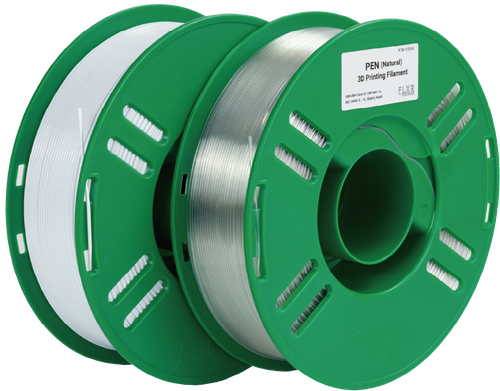


Description
FLXR PEN Natural Biocompatible 3D Printer Filament – For Microfluidics, Medical & Laboratory Applications
PEN (Polyethylene Naphthalate) is a high-performance, biocompatible engineering thermoplastic filament developed for 3D printing functional components used in microfluidics, biotechnology, pharmaceutical processing, and laboratory applications.
Unlike conventional 3D-printing materials, FLXR PEN is designed for applications where material purity, chemical resistance, low extractables and leachables (E&L), and sterilization compatibility are important.
Its combination of mechanical durability, chemical resistance, and biological compatibility makes it an excellent material candidate for manufacturing custom microfluidic devices, fluid-contact components, laboratory fixtures, and specialized biomedical prototypes.
Key Features & Benefits
-
Biocompatibility: USP Class VI and ISO 10993 testing, including testing performed on 3D-printed specimens.
-
Low Extractables & Leachables: Low E&L potential helps minimize the risk of unwanted material contamination in sensitive fluid-handling applications.
-
Chemical Resistance: Suitable for a broad range of solvents, chemicals, and process fluids. Consult the chemical compatibility chart before use.
-
Sterilization Compatibility: Compatible with gamma irradiation, ethylene oxide (EtO), vaporized hydrogen peroxide (VHP), and autoclaving, subject to process-specific validation.
-
Smooth Printed Surface: Produces a smooth surface finish within the FDM filament category, with low friction and good wear resistance.
-
High-Purity Manufacturing: Manufactured in an ISO Class 8 cleanroom under an ISO 9001:2015-certified quality management system.
-
Reliable Printing: Consistent filament diameter and controlled manufacturing processes support repeatable 3D printing.
Applications
FLXR PEN Natural is particularly suitable for:
-
Microfluidic Devices: 3D-printed microfluidic chips, manifolds, connectors, fluidic channels, and custom fluid-handling components.
-
Laboratory Equipment: Fluid-contact fixtures, adapters, holders, and custom laboratory components.
-
Biotechnology & Life Sciences: Components used in biological sample handling and sensitive fluid-processing workflows.
-
Pharmaceutical Processing: Custom fluid-contact components for pharmaceutical and bioprocessing equipment.
-
Medical Device Prototyping: Functional prototypes and components requiring biocompatible material properties.
-
Custom 3D-Printed Labware: Durable, chemically resistant laboratory accessories and specialized equipment.
Sterilization
PEN can be sterilized by different methods without compromising the quality. The followings methods are validated by the manufacturer:
| Process | Requirement |
|---|---|
| E-beam | ≤ 30 kGy E-beam radiation, maximum 80 kGy |
| Ethylene Oxide | 100% Ethylene oxide at 55°C for 16 hr |
| Gamma | ≤ 50 kGy gamma radiation, maximum 80 kGy |
| Autoclave | Autoclave at 132°C for 20 min or at 121°C for 30 min Shrinkage of 3% in the X-Y direction and an increase of 2% in the Z direction. |
Recommended 3D Printing Parameters
The manufacturer suggest the following print parameters as the starting point. If you are using Bambu or Ultimaker S-series, please contact us for the printer profiles.
Note 1: Disable bridging in your slicer.
Note 2: It is critical to perform a flow calibration prior the print. Under flow results in leakage and overflow can constrict the channels in microfluidic chips.
| Value | |
|---|---|
| Nozzle Size | 0.2 - 0.6 mm |
| Nozzle Temp. | 280 - 300°C |
| Bed Temp. | 80 - 100°C for PEI & 85 - 105°C for glass |
| Enclosed Chamber Temp. | 40 - 55°C |
| Drying | 70 - 80°C for 4 - 6 hours |
Why Choose PEN Over Conventional 3D Printing Materials?
Conventional PLA, PETG, and standard engineering filaments may not provide the combination of biocompatibility testing, chemical resistance, low extractables, and sterilization compatibility required for demanding laboratory and fluid-contact applications.
FLXR PEN provides an alternative for engineers and researchers developing functional, application-specific components without relying on resin-based printing and its associated washing and curing steps.
Product Video
Product Documentation
FDM Filament Chemical Resistance Chart
Looking for a biocompatible filament for your next microfluidic or laboratory project? Contact ELEXAN Scientific for product information, technical documentation, and assistance evaluating PEN for your application.
Frequently Asked Questions
Is PEN filament biocompatible?
3D-printed PEN specimens have passed USP Class VI and ISO 10993 biological safety tests. Final suitability depends on your part, process, and application, so qualify your full print workflow.
What is PEN filament used for?
Microfluidic chips, bioreactor components, lab and pharma parts, medical device prototypes, and food-contact processing components.
Is PEN filament PFAS-free?
Yes. SGS testing reported no PFAS detected at ppb level.
Can PEN 3D printed parts be autoclaved?
An enclosed FDM printer that reaches 280–300 °C at the nozzle, with a non-brass nozzle. Examples include Bambu Lab X1C and H2, UltiMaker S-series, Raise3D Pro series, and Prusa Core One.
What printer do I need for PEN?
An enclosed FDM printer that reaches 280–300 °C at the nozzle, with a non-brass nozzle. Examples include Bambu Lab X1C and H2, UltiMaker S-series, Raise3D Pro series, and Prusa Core One.
How is PEN different from PETG or PC-ISO?
PEN has higher heat and chemical resistance than PETG and is easier to print than PC-ISO. It is also additive-free and PFAS-free.


